
.png) Partner Elevate
|
Dec 12, 2025 01:22 pm
Partner Elevate
|
Dec 12, 2025 01:22 pm
AI is shrinking billable hours for channel partners by reducing the time needed for production-heavy work. As effort becomes easier to compress, value shifts away from hours and toward outcomes, governance, and delivery accountability. To protect margin and stay competitive, partners need a new services engine built around productized outcomes, governed delivery systems, and repeatable delivery.
For years, channel partners across cloud, infrastructure, data, cybersecurity, and applications have grown professional services the same way. Sell a project, staff a team, bill the hours, then scale margin through leverage.
AI is quietly undermining that model.
Not because consulting disappears, but because the production layer of services work is being compressed. Research, synthesis, documentation, reporting, and first-pass analysis are happening dramatically faster. When effort shrinks, time stops being a reliable unit of value.
The real issue is systems replacement, not headcount reduction.
How is AI shrinking billable hours for channel partners?
The simplest way to understand what is happening is this:
AI reduces effort. It does not reduce responsibility.
Across every partner-led consulting motion, clients still expect:
- sound judgment
- defensible recommendations
- correct implementation
- measurable outcomes
- clear accountability if something fails
AI can accelerate work. It cannot own delivery risk.
As effort drops, the question every services leader must answer becomes unavoidable: what are we actually getting paid for now?
That is why AI billable hours is not just a pricing problem. It is a delivery model problem.
Why are traditional services models under pressure?
Channel partners sit in one of the highest-velocity parts of the services market. Much of the work is repeatable, execution-heavy, and increasingly recognised by buyers as production.
AI compresses time for:
- discovery capture and requirements synthesis
- assessments, baseline analysis, and gap mapping
- architecture diagrams and technical documentation
- configuration plans, migration runbooks, and reports
- executive decks, QBRs, and roadmap artifacts
When these take significantly less time, hourly models weaken, rate pressure increases, and utilisation becomes harder to protect.
Margin erosion starts here, not because value disappears, but because value is no longer measured in hours.
Which channel partner services are most exposed to AI?
Not all services are hit equally. The pressure concentrates where work is repeatable, document-heavy, pre-implementation, and framed as analysis rather than outcomes.
High-exposure areas
- assessments and readiness engagements
- strategy and roadmap projects
- compliance, governance, and documentation-heavy work
- discovery-heavy cloud and data migrations
- architecture design without implementation ownership
Lower-exposure areas, for now
- implementation with clear acceptance criteria
- managed services and ongoing operations
- complex integration and change-heavy programs
- outcome-based transformation work
The more your revenue depends on producing artifacts, the more pressure you will feel.
Why does AI compress effort but not accountability?
The traditional services pyramid was never just about leverage.
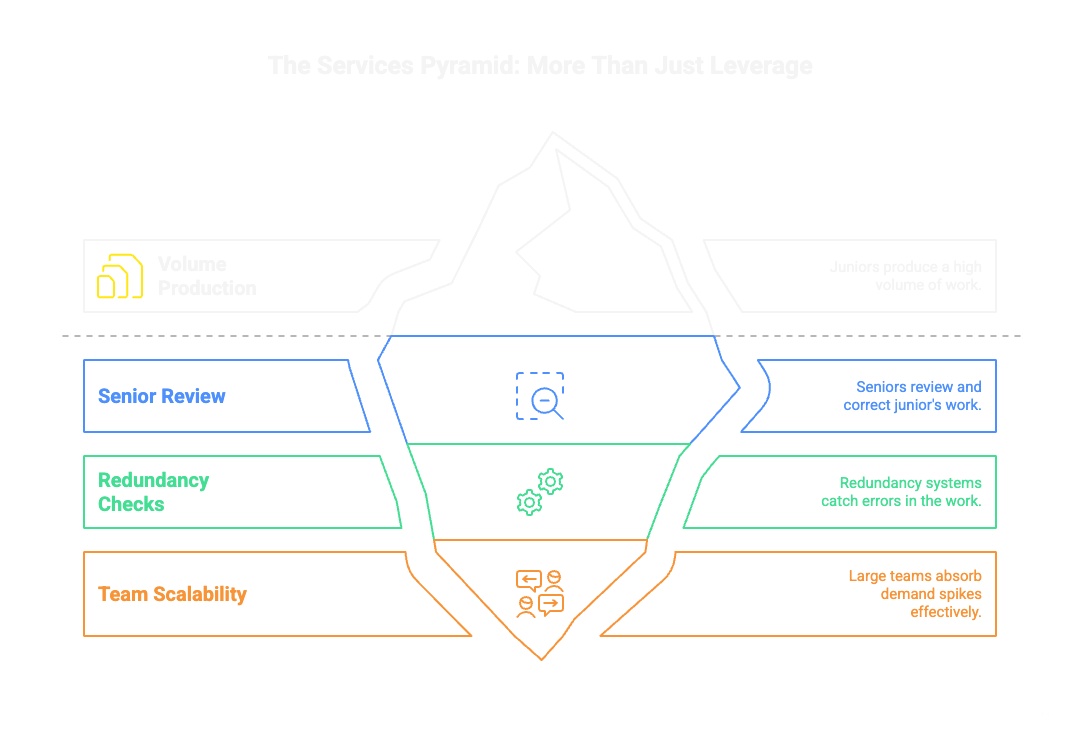
At the surface, junior consultants produced a high volume of work, allowing firms to scale delivery efficiently. Beneath that sat a set of hidden control systems that most partners relied on without explicitly designing for them.
Senior review transferred judgment and accountability.
Redundancy caught errors before they reached the client.
Large teams absorbed demand spikes without breaking delivery.
Together, these layers created quality, resilience, and trust, even when delivery pressure increased.
AI compresses the top of the pyramid first by automating production work. In doing so, it quietly destabilises everything underneath. When junior effort disappears, those hidden control systems disappear with it unless they are deliberately replaced.
If review, quality assurance, and surge capacity are not rebuilt through governed workflows, explicit quality gates, and repeatable delivery systems, partners do not just lose billable hours. They lose consistency, delivery resilience, and confidence in outcomes.
This is why the challenge is structural, not tactical.
What replaces the billable-hours model for channel partners?
The strategic question is no longer about cost or utilisation.
If the pyramid thins, what replaces it as your delivery engine?
The emerging winning model is not simply “use more AI.” It is a redesign of how services are packaged, delivered, and defended.
Three shifts define the next model.
1. From projects to offers
Instead of selling services, sell defined outcomes with clear scope and acceptance criteria. Value moves from effort to results clients can validate.
2. From deliverables to defensibility
As artifacts commoditise, differentiation shifts to decision quality, implementation correctness, validation steps, traceability, and accountability. AI produces content. Partners produce confidence.
3. From junior leverage to repeatable systems
Scale now comes from playbooks, reference architectures, standardised delivery patterns, explicit QA gates, and automation embedded in governed workflows.
This is how firms scale without relying on large junior cohorts.
What does a new services engine look like for channel partners?
You will know the shift is real when you see:
- pricing move from time-based to fixed or outcome-based
- smaller teams delivering equal or better results
- roles shifting toward specialists and implementers
- services packaged as modular sprints or programs
- governance and QA becoming explicit, not assumed
These are not small operational tweaks. They are signals of a services engine being rebuilt.
A new services engine for channel partners is built on:
- productized outcomes
- governed delivery systems
- repeatable delivery patterns
- stronger quality control
- accountability that clients can trust
That is what replaces a model built mainly on hours.
How can channel partners shift from projects to productized outcomes?
Every channel partner with a professional services business now faces the same choice.
Continue selling effort in a world where effort is shrinking, or redesign services around repeatable outcomes delivered through governed systems clients trust.
That means:
- defining clearer offers instead of vague project scopes
- pricing around outcomes where possible
- replacing hidden review layers with explicit quality gates
- reducing dependence on junior leverage
- building delivery systems that scale without losing confidence or control
The firms that move first will not just protect margin. They will create a more defensible business model.
Key takeaways
- AI is shrinking billable hours by compressing production-heavy work
- Time is becoming a weaker proxy for value in partner services
- The most exposed services are repeatable, document-heavy, and pre-implementation
- The real risk is not just lost hours, but weakened delivery systems
- The winning response is productized outcomes with governed delivery
- Repeatable systems matter more than junior leverage in the next model
Conclusion
AI will commoditise service production. It will not commoditise delivery accountability.
That is the core shift.
The partners who win will not be the ones who simply use AI more aggressively. They will be the ones who redesign how services are delivered, priced, and trusted.
As effort shrinks, the question is no longer how to protect the old model. The question is what replaces it.
For channel partners, the answer is a new services engine built around repeatable outcomes, governed delivery, and execution clients can trust.
Build a more defensible services engine
If your services model still depends on billable hours, now is the time to redesign it. Partner Elevate helps channel partners build repeatable offers, clearer positioning, and execution-ready growth systems.
Recent Articles
- AI Billable Hours: Why Channel Partners Need a New Services Engine
- How AI Discovery Is Changing B2B Software Buying, Marketplace Checkout & Partner Impact
- AWS Partner Capability: Why It Now Drives Success and Revenue
- AWS Partner Multiplier: Why Capability Is Your Growth Advantage
- Offer Creation Formula Case Study: How Intergy Improved Lead Conversion
- How to create opportunity for lead engagement using sales enablement platform
- Case Study Creation Process: Build Credibility for Channel Partners
- How to Connect With Prospects Without Wasting Time on Cold Leads
- Lead Magnet Strategy: How to Build Your List | Partner Elevate
- Steady Lead Generation: How to Attract Interested People